On November 5th 2012 a grade IV glioblastoma multiforme tumor was removed from my 56 year-old mother's right medial temporal lobe. She passed away January 29th 2014. My hope is that these pages help me work out the myriad ways in which our lives so drastically changed, and maybe also help other caregivers.
Showing posts with label cancer. Show all posts
Monday, December 16, 2013
well, shit.
Literally. Now comes the long-awaited journey of incontinence. It was bound to happen sooner or later, though I had hoped we would have hospice or some home health help before that point.
I haven't written here in a little while--things have been busy.
Mom is increasingly weak and constantly fatigued. She spends all day in bed--and I mean all day. Last night was her last dose of chemo this round and I'm hoping that we can get hospice in now as they can't be called in if the patient is still on any aggressive curative treatment [added to the Practical Tips post here!]. She is understandably on the fence about hospice. In her mind it is synonymous with death, as it is for most Americans. What I've learned, though, is that every single person who writes or talks about hospice says the same thing: "I wish we'd done it sooner." Hospice is a part of the journey, not it's end! There is still life after stopping treatment, and the patient might even feel better without so many drugs in the system. No chemo brain!
Throughout this whole thing I've kept strange hours; sleeping in late because she does, staying up late because the wee hours are the most peaceful here. Now I'm followed by the constant hum of a baby monitor. Hum isn't the right word, though. The default static that comes through is low and constant, a little scratchy, like holding a conch shell to your ear. There should be a word for just that sound. Because of her weakness, and her weak voice (did you know that is a side effect of Avastin?), I picked up a baby monitor set at Habitat for Humanity ($5!). I leave it on my nightstand at night to charge, and take it around the house with me during the day. Just like a mom. (On an unrelated note, here is a very interesting short essay on not having kids). I'll be adding the baby monitor to that list of Practical Tips, too.
Good things.......well, my godmother/mom's best friend visited again. We absolutely love having her here. She's full of energy and has a beautiful healthy laugh. She was determined to get me started on some projects in the kitchen (my defense/coping mechanism is home improvement) and she succeeded. Twelve years of avocado green plaid wallpaper (with matching drapes), and now it is all painted a fresh, clean beige. I've removed the soffit from over the sink to add some height and am currently in the messy "slather it with joint compound and sand it all away the next day" phase. Up next: paint the cabinets or install the new flooring. Can't decide where to start.
Another good thing: sold mom's car! It has been sitting there for a year. Excellent car, clean, low mileage, just sitting there depreciating. A friend of a friend's grandson is turning 16. Happy birthday! And thank you! We really needed that money.
Possible good thing: somehow I survived healthcare.gov. I needed to lower mom's premium (I discussed earlier how it would have doubled next year) as well as get my own health insurance. I went through the process on the phone with a very nice young man who, at the end, said I wasn't eligible for tax credits or cost-sharing. Um, what? I'm unemployed, dependent on my permanently disabled mother whose only income is SSDI...aren't we the poster children for the Affordable Care Act? So I went online and did it myself and, lo and behold, the two of us will be getting excellent coverage for $70 a month...that includes both of us....$70....Obamacare, how do I love thee? Let me count the ways...and let me pray there are no red tape hiccups or hidden fees.
My dad visited. It is an innocuous statement for anyone who doesn't know my family. Long story short: my grandparents basically disowned him when he left my mom. Mom and I moved in with them (her in-laws). They became the closest family we've got. Lots of tension, lots of water under that bridge. He wanted to see mom, to apologize, and to see his parents. I never thought I'd see the day when we all sat down for dinner together. It was truly surreal. Damn does life change fast.
It's now been almost 14 months since mom's craniotomy. Her cognitive abilities continue to decline in the sense that she seems to process things extremely slowly, or not at all. She is terribly weak and often needs help sitting up, getting out of bed, and definitely getting in and out of the tub. Increasingly incontinent, as noted above. She still has moments of emotional clarity when she experiences intense sadness, but I think these fade quickly, thankfully. With the discovery in the ER of new emboli, she has been taken off Avastin (which can increase chance of clotting) and Lovanox (which apparently wasn't working). She is now on Pradaxa, a different blood thinner that, of course, does not have a generic. We have another MRI in about a week, and meet to see the results on Christmas Eve.
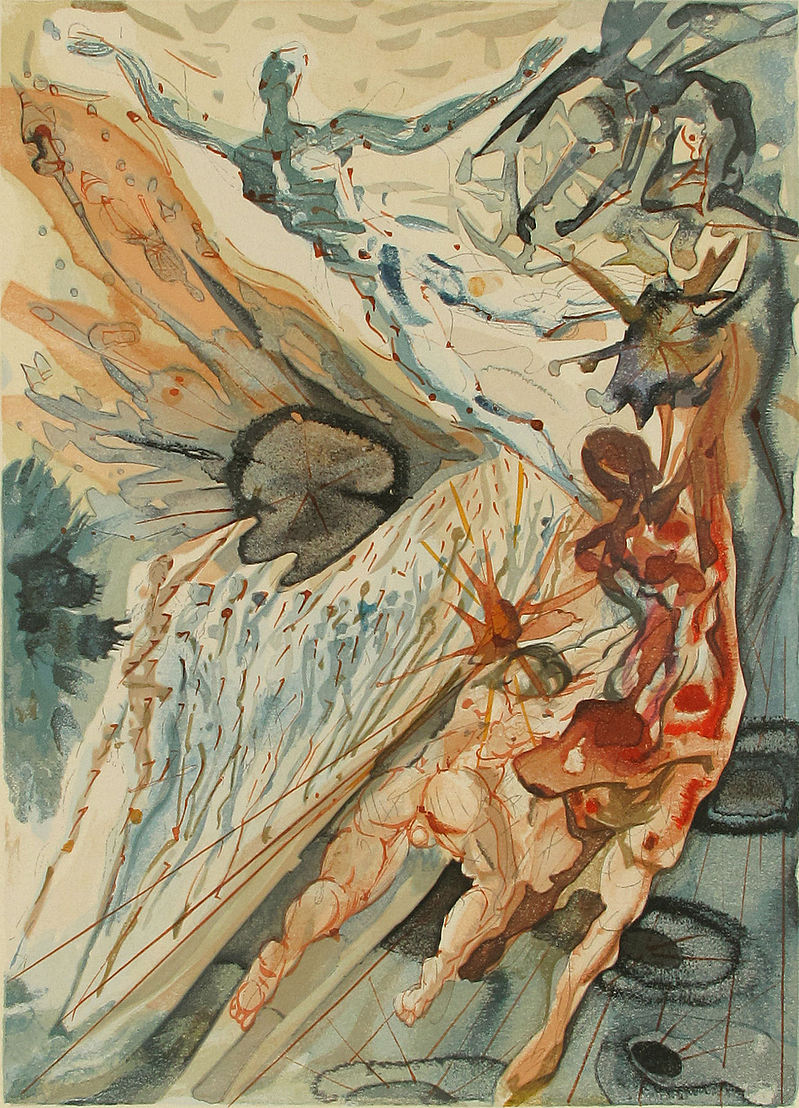
Image: I read Marvell's "To His Coy Mistress" again the other day, first time in years, and I still love that line "But at my back I always hear/Time's winged chariot hurrying near." The image is from Dali's Divine Comedy series, Purgatory Canto 26. I feel that they work together.
Labels:
advice,
Avastin,
brain cancer,
cancer,
caregiver,
gbm,
glioblastoma,
insurance,
tips
Thursday, October 10, 2013
life in the ship is beautiful
Today mom thought she was on a ship, her bedroom one of many staterooms. I opened the blinds (which she always keep shut) and showed her our front lawn. That settled that. But it seemed a delusion a propos my previous post and I wanted to share.
It reminds me also of a quote from Iron Island (Jazireh ahani), directed by Mohammed Rasoulof. An abandoned oil tanker in the Persian Gulf becomes a home to many poor families. It is slowly sinking. The "teacher" to the many children on the boat has them repeat the following each day. I paraphrase:
"The sea is vast and spectacular.
The ship sinks more in the sea each day.
Life in the ship is beautiful."
I think it's a lovely credo.
Image: Gentile da Fabriano's "St. Nicholas Saving a Ship from the Tempest," c. 1425, link, from the predella of the Quaratesi Polyptych.
Wednesday, October 9, 2013
such stuff as dreams
Earlier this evening my mom came into my room crying. She's been extremely emotional lately, crying often, and she was concerned tonight about me. She worries about what will happen to me when she's gone, and I would imagine she worries about those last moments--where she'll be, if I'll be there, if she'll be in pain, etc.
"I'd like to be sitting with you, drinking a glass of wine," she said. She hates wine, but I know the sentiment. She wants to meet death on her terms and that is a situation that very few of us are ever afforded. And so I briefly began to look at, for lack of a more pleasant yet concise term, euthanasia. Needless to say that didn't last very long. I like the idea of us both sitting down, saying "enough," and enjoying each others' company as it ends. But she's stubborn and I can't imagine her ever reaching a point where she has had enough. Were she in pain, yes, she would ask for relief, but I don't think she would consider that as accepting death.
It has taken her over a year to come to terms emotionally with her prognosis. She still has moments when she thinks she can "beat" it, but for the most part she acknowledges that this will kill her. It's a sudden wave for her. For me it has been a sea change, the slow ebb of the woman who was my mother. I've had over a year to grieve, slowly, and in my own (surely unhealthy) way.
After writing the above I decided to look up the origin of the term "sea change." Wikipedia and Shakespeare...what would life be without them?
"Full fathom five thy father lies,
Of his bones are coral made,
Those are pearls that were his eyes,
Nothing of him that doth fade,
But doth suffer a sea-change,
Into something rich and strange,
Sea-nymphs hourly ring his knell,
Ding-dong.
Hark! Now I hear them, ding-dong, bell."
-From The Tempest Act 1 Scene 2, here. The brief wiki article is here.
Appropriate I think.
Image: John William Waterhouse's "Miranda," 1875.
Friday, September 20, 2013
practical tips for the brain cancer caregiver
People often use the term "battling cancer." Going to war means raising an army, and there are tons of people out there whose sole purpose is to support you. Start building your army/team/whatever from the beginning. Below I've started breaking down the areas of greatest need. I've put down examples of resources and things/people I've found important or useful. This is by no means comprehensive, but it's a start for those of you who, like me, were thrown into a very complicated situation with no warning or experience. I hope to update this as time goes by, adding what I've experienced and learned.
- Legal
- Will, living will, power of attorney, estate planning. Get all this out of the way early while you're still motivated by whatever sicko neurotransmitter creates energy from shock and tragedy.
- Recruit: most county bar associations should have some sort of referral service to put you in touch with an attorney who specializes in your needs and won't charge you an arm and a leg. For example, I just found an elder law attorney in our area through such a referral program who will charge no more than $50 for an initial consultation. Write down a list of questions and make the most of that half hour (or however long). There might also be resources through local law schools, or reduced/pro bono clinics.
- Medical
- Medications
- Avastin: can give the patient a squeaky and/or weak voice.
- Be prepared for change. A drug might work great for a while (for us, it was Temodar). After a stint in the hospital we restarted it--lo and behold, mom is allergic to it! The steroids she had been taking masked her reaction. Know that there are many options and that you will, almost certainly, try several.
- Hospice
- Don't put it off. Call them in when you first need them. You're not stuck with them! If your patient jumps out of bed one day, fit as a fiddle, you can send them packing.
- The patient can't be pursuing aggressive/curative treatment if they choose to go into hospice care.
- If you aren't ready to stop treatment, a lot of nurses/hospice workers "moonlight" in home health. Ask around. A friend of a friend has a registered nurse who works with hospice come out to her aunt's house regularly for only $15/hour!
- Recruit: your team's social worker. They will know just the person for you to talk to at the local hospice agencies.
- Financial
- Insurance
- Keep up with premium payments (don't let the bills disappear into stacks of papers)
- Recruit: insurance providers sometimes offer complimentary services such as a case manager. We've been offered one but haven't yet followed through. I'm not sure what he/she does, but the more the merrier!
- Hospital
- Whatever treatment isn't covered by insurance does not necessarily need to be paid off right away. Get in touch with customer service and set up a payment plan. Sending out ten $25 checks a month to different providers might seem tedious, but you're basically just paying off an interest-free loan. Save the big chunks of money for other things.
- Patient-assistance programs. Chemotherapies and other medications are freakin' expensive. If your insurance doesn't cover the full cost (or any cost), many drug companies offer patient-assistance programs. Example: my mom's Temodar was shipped to our house monthly and we didn't pay a penny.
- If your assets are low enough, you may qualify for charity programs through your hospital.
- There might be limited grants available through the hospital. For example, one month our social worker applied to a grant for us that covered one month's mortgage payment. I never, ever, would have thought to look for something like that.
- Recruit: social workers. The brain tumor clinic at our hospital has amazing social workers who know the ins and outs of all of this stuff. They walk on water and surely don't get paid enough.
- Recruit: In our clinic there is also a patient assistance liaison who handles the aforementioned financial relief programs.
- Assets
- Cancel the patient's car insurance if they are unable to drive, and consider selling the car. In our case, my mom will never go back to work and her doctors have told her she can't drive. It took me six months to realize I should cancel the insurance. Now the car is sitting there, depreciating in value with each day.
- If you have money sprinkled all over the place, now is the time to get it in order. Everyone's situation is going to be very different, but here are some general points I've learned:
- If you are legally disabled you are exempt from the 10% additional tax applied to early withdrawals from retirement accounts.
- If you're thinking of moving money around or selling property, be aware of capital gains taxes. If your income is low enough (example: we are in the 15% tax bracket currently) you will be exempt.
- There are all sorts of strange breaks/benefits for a person on disability. For example, a free lifetime pass to our national parks (who would've thought?!). Also, in our county we can get a break on property taxes up to 50%. Do research for your state and county. Be persistent.
- Recruit: if you already have a financial advisor, awesome. If you don't, the decision to approach one depends entirely on you and your level of comfort with managing your finances.
- Recruit: There are tons of excellent online resources, not the least of which is the "Bogleheads" forum and wiki. It's basically a group of smart people who geek out over financial stuff, particularly investment planning. They critique one anothers' portfolios and are kind enough to answer questions from dummies like me.
- Social Security
- Apply for Disability Insurance as soon as possible. With brain cancer it is pretty much guaranteed and they can sort of "fast-track" you through the system. You want to start early because, though SSDI means you are automatically eligible for Medicare, there is a 24-month waiting period before those benefits can take effect!
- Personal
- Prepare yourself mentally and emotionally for long periods of waiting. You will wait for everything. Appointments, medicine, results, answers, relief, help, calls...everything.
- Create a healthy routine from the start. Things are crazy and hectic in the beginning, and if you don't start off with healthy living in mind, it will be near impossible to implement later. Get outside each day. Plan your meals. Give yourself a break from caregiving. I've fallen into a routine of only leaving the house for appointments and grocery shopping--that's not living.
- Get accustomed to the "new normal." That goes for both caregiver and patient. Things will never be the same as they were before your diagnosis, so don't set expectations that you will surely fall short of!
- Make lists. Things to do. Things that make you happy. Ways to relieve stress.
- Recruit: friends and family, obviously. Personally I have a hard time asking for help--that is, I don't even realize I need help until it's too late and I'm overwhelmed. Be open and honest with your friends and fam from the beginning. Tell them the situation and gauge how willing they'll be to step in and help out, even if it's just coming over and chatting for a while. Some people handle this sort of stuff better than others. One of my mom's friends, for example, doesn't handle illness and the thought of mortality well--she sort of spaces out. You can't force people to be there for you, but you can set appropriate expectations for yourself from the beginning.
- Recruit: Seek out a psychiatrist. This goes for both the patient and the caregiver. If you've never been to a therapist before, you'd be surprised just how helpful it is to simply talk for an hour. You can lay out the whole situation to a stranger and not worry about putting things delicately or biting your tongue about things that might otherwise make you feel guilty.
- Recruit: Your hospital or clinic will have information on support groups. Go to them! Our hospital has a dozen different groups. There is one specifically for brain tumor patients and their caregivers, which we have yet to visit. There is also one for caregivers only. I went to that once and it was wonderful.
- Random
- Receiving unemployment: teaching assistantships (such as what I had during graduate school) do not count as eligible wages regarding such matters as unemployment benefits. BUT, if you had to leave your "real" job to care for a disabled family member, as noted in a previous post, you'll be eligible. It's an exception to disqualification that isn't usually mentioned on general descriptions of your state's unemployment policies, so take a look at the actual statutes. Legalese is dull, but you can find gems!
- Buy a baby monitor set! Even if you don't need it yet, if you spot a good deal, grab it. I got mine at the local Habitat for Humanity ReStore for $5. If mom is too weak to get out of bed or needs something, I can hear her from anywhere in the house if I carry the receiver with me. Worth it's weight in gold.
- On a similar note, consider buying something like this "remote wireless key finder." I bought this for a few bucks (price has increased, apparently) months ago in order to keep track of mom's cell phone. She would wander around with it, lose it, and calling to find it was no help because it was on silent. I bought a case with a ring for attachments and put this receiver keychain on it. Hit the button on the transmitter keychain and it starts beeping. These days, mom can't even turn on the phone, so I'm repurposing these. The transmitter will go on a lanyard around her neck, and I'll have the receiver by my bed. If she calls through the monitor while I'm asleep I rarely hear her. Or, like today, I found her on the floor of her bathroom. It's like that Life Alert "Help I've Fallen And I Can't Get Up!" but way cheaper.
Last updated 12/18/2013
Image: Jacques-Louis David's "Napoleon Crossing the Alps," 1801, link.
Labels:
advice,
brain cancer,
cancer,
caregiver,
disability,
finances,
gbm,
glioblastoma,
legal,
mental health,
tips
Friday, September 13, 2013
too much
If it were just the clogged kitchen drain, it would be fine. But it's not.
It's also the bathtub full of dirty dishes that must be washed there before I can get in to take a shower.
And once I rent the electric auger to get up to the roof vent to unclog the drain, I won't be allowed. My grandfather and some "buddy" will be by to do the (rather simple) job without me. Because I "don't need to know how to do that sort of thing."
And it's the sink, too, the handles of which have come loose and now turn nearly 360 degrees before the water shuts off.
And it's the refrigerator, which leaks pools of water at random intervals.
And the water heater, whose swan song sounds like a thunder storm.
The oven has a mind of its own, working when it pleases.
One entire wall of electrical outlets don't work.
One of our cats chooses to shit not in one of the two litter boxes, not on the linoleum spread around them, but on the hardwood floor just beyond.
Water damage was repaired around the chimney and I still have yet to paint the trim and mantle.
The windows need reglazing.
Our home is falling apart all around us, but it is a "good" day if I'm able to get out of bed before noon and pick up mom's prescriptions. Where do I find the energy to tackle any of the above? I have no desire to eat. If I don't have a terrible headache then it's debilitating nausea. What would I do without Netflix and beer?
Image: Eugene Atget's "Chiffonier" ("Ragpicker"), link.
Wednesday, September 11, 2013
and more pills
After six months of only Avastin, the doctors cleared mom to once again take Temodar. She would be taking a low daily dose of 80mg. We began Monday night, and Tuesday she woke up with a pink, swollen face. Nearly two days later the reaction hadn't subsided and the doctors have started her on a steroid. We are, of course, not taking the Temodar.
She's extremely disappointed. In her mind, Temodar is a sort of wonder drug. It was the first anti-cancer drug she began taking after her diagnosis and resection, and we saw shrinkage of the tumor. After a few months on both the Temodar and an experimental drug from Eli Lily, she was hospitalized with pneumonia. At first they thought it was an infection, but eventually realized it was a drug-induced pneumonitis--one of the drugs had caused the reaction. Since the Lily drug was still in testing we all hoped it was that and that, eventually, she could get back on Temodar. After this past week, however, it seems that it wasn't the Lily that was the problem.
In short: cancer sucks. Being allergic to the proper chemotherapies double sucks.
Image: Beverly Fishman's "Pill Spill," installation, 2011.
Monday, September 2, 2013
making time
I have issues with procrastination. And responsibility. Unless there is a deadline or someone by whom I am held accountable, things don't get done. Last month I forgot to pay mom's health insurance premium. Of all the bills I could've forgotten, that is the worst. I mean...brain cancer is expensive, y'all. But I let things slide, tuck papers into folders, and then weeks go by and all the bills are printed in bright red ink.
I stumbled upon this website today. I haven't used it (yet), but I think it could be a valuable tool. Setting an alarm or writing something in my planner...eh, those I kind of brush aside. But if I'm at my computer and *poof* a chastising email from myself appears in my inbox, well, perhaps I'll actually do something.
http://www.futureme.org
Image: Dali's "The Woman in the Cosmos Dominating the World," lithograph, 1957, link.
Thursday, August 29, 2013
a few things i'd like to do
From what I gather, my mom has no regrets. She doesn't say "I wish I had..." She doesn't seem to feel as though she's missed out on life. I'm grateful for that.
The following is not a list to be checked off so that I rest peacefully. The list is to help me focus, to maintain a sense of wonder, and to inspire and motivate me. Inspired by Maggie of Mighty Girl. See her Life List here.
Visit an English bluebell wood
Live off the land
Ride a motorcycle
Fly a helicopter
Write a book (and publish it)
Make a living doing something I love
Dinner at a top 50 restaurant
Go back to Ireland (and attend the Cape Clear Storytelling Festival)
Make exercise a part of my daily life
See the Grand Canyon
Feel sexy and confident again
Fish for dinner
See the redwoods
Learn to whistle
Bedside peonies
See the Aurora Borealis
Build a house
Be conversational in five languages, English excluded: 1. Arabic, 2. Turkish, 3. French, 4. Farsi, 5. ?
Memorize five poems or speeches: 1. Renascence, 2. Romance Sonambulo, 3. 4. 5.
Be there for B and R
Finish my MA
Get a PhD...?
Fall in love again
Ride in a seaplane
Visit Iran
Rock red hair
Really learn to play chess
Finish an oil painting
Take B and R to the Aya Sofya
Visit Patagonia
Do something special for A
Learn how to keep in touch with people
Start making books again
Do anything for PTSD vets
Adopt a german sheperd rescue
Image: bluebells in England
Sunday, August 25, 2013
growth
We had an MRI scheduled for this past Tuesday, and on Wednesday the images confirmed my suspicion, that mom's cancer had grown. The images showed growth by a few millimeters at several nodes, or whatever they're called, as well as a new area of growth. Certainly explains her behavior. She took the news surprisingly well, though I think a lot of that might have been her confusion. So we'll begin Temodar again, which she stopped when she was hospitalized for pneumonitis. Since March her only cancer treatment has been Avastin.
She is still confused about cars, houses, and me. While I was still asleep this morning she left the house. She's gone on a few walks before, which we've told her aren't safe. She could get lost, hit by a car, mugged, etc. I woke up to a phone call from my grandmother, whose golf friends had seen my mom wander across the course nearby. I drove up and down the streets. The sheriff sent a car out to help look. I got her on the phone a few times, but she has so little focus that she couldn't tell me where she was. About forty minutes after she left the house I found her. She was wearing black wool--it was 95 degrees outside. She was covered in grass clippings. I took her inside and she passed out on the sofa.
In an ideal world we'd find a great assisted living place nearby that magically paid for itself. I'd pack up the house and sell. I'd get a cheap apartment near downtown and return to some sense of independence. I could work part-time again and spend the rest of my time with mom at the facility. Maybe I'd start writing my thesis and finish my MA. Yeah, that'd be nice.
Instead, we're increasing the Risperdal, hoping it helps with her confusion and delusions. At night I take all the keys out of the deadbolts so that she can't open any exterior doors while I'm asleep. Last night I slept for nine hours and it was glorious; I only woke up twice to check and make sure she was still in the house.
Image: Andrew Wyeth's "Christina's World," 1948.
Wednesday, August 21, 2013
mom and metaphysics
Things get caught in the web that is left of my mother's mind and they're impossible to remove. She forms connections between bits of information and spins a story that is completely separate from reality. Currently she believes that we are living in someone else's house, housesitting maybe, but the house is suspiciously like our own. When she forgets that I'm her (unemployed) daughter, she thinks I work for Duke, since I shuttle her to and from appointments and arrange all her medications. I mentioned selling her car, and now she believes that she got a new car, but one that looks almost exactly like her old one.
I'll tell her every ten minutes, "mom, this is our house, you own it, you bought it in 2001 and no one else has ever lived here but us," but it doesn't stick. I can never tell if she believes me, and even if she does, she just forgets again.
I wrote before that she thought there was someone impersonating me and wanting to be her daughter. Today she started calling this alter-ego Pace. I'm noticing a pattern--she attributes more unpleasant memories to Pace. So, when I argue with her, when I make her get up early for appointments, and when I tell her she can't wear a pajama shirt as a pair of pants she remembers Pace.
Dropping everything and caring for my mom has been surreal. And as she tells me day after day that there are two of me, that there are two houses, sanity and reality start to fade. Her imaginary world, though I know it is false, begins to feel like there might be some substance behind it, if only because it is, in her mind, so vivid. And anyway, who's to say we aren't all of two natures, one gentle, the other not so much? Ontological paranoia...add it to the list.
Image: still from Krzysztof Kieslowski's "La double vie de Véronique," 1991. An amazing film!
Saturday, August 17, 2013
what the?
It seems like everyday I find something that makes me cock my head and wonder. Today I found the above.
That's a picture of a stick of butter, half melted, and a bag of brown sugar sort of melted into it. What the hell, ma? She'd left it in the fridge...just in case....?
depression
I'm not sure if it's possible to be a family caregiver and not develop depression. Strange as it may sound, I think I'm lucky that I've dealt with depression before all this started. It takes many forms, and I think it's important for caregivers to seek support from the start. Not the start of feeling sad or numb, but the start of being a caregiver. I had (and still have) a list a mile long of things that need doing. They range from stupid little things like vacuuming the house to the big things like researching assisted living. With a list like that, finding a psychiatrist or support group might not seem a top priority. Oh, how very very wrong we are.
If you're a caregiver and you aren't already seeking some sort of support (independent of your loved one), do it now.
If you know a caregiver, or if someone is caring for you, and you don't understand depression, read these. She's hilarious, but she's also spot-on.
Adventures in Depression Part 1
Adventures in Depression Part 2
Image: Erwin Olaf's "Irene" from "Grief," 2007, link.
Friday, August 16, 2013
difficult conversations: driving
There are many difficult conversations to be had with a brain tumor patient. The one I've found the worst, so far, has been driving. I distinctly remember one day a feeling I had never felt before--damned if you do, damned if you don't. I thought I knew what that felt like, but until I had to talk to my mom about her driving I had been all wrong. Should I be the bad guy and keep her cooped up? Or should I put her (and other drivers) in harm's way and allow her to drive? She was an adult still, right? Who am I to tell her no?
Yeah, driving is essential to one's sense of autonomy. It was something more for my mom, though. She has always been fiercely independent. Single mom working two jobs to support us, I mean, it's a Lifetime movie. No handouts, no gimmes, no free lunches. Now she feels like a prisoner in her own home. The creeping paranoia fueled by the cancer led her to feel that "we" (my grandparents and myself) were trying to keep her boxed in.
The options?
- Take the keys, sell the car; do whatever it takes to keep her from driving. She's lost something like 75% of her peripheral vision, her concentration has dropped to near zero, and her memory is shot to hell. Sometimes she doesn't know where we are when I'm driving us down our own street.
- Let her drive, wait until she gets in an accident to say "I told you so," and hope that no one else was hurt that might sue us and take everything.
If there are other caregivers reading this, here are some of the hoops we've jumped through that may or may not benefit you and your loved one:
- In-clinic tests. The brain tumor clinic at our cancer hospital offers a battery of neuro-cognitive tests, one of which is a driving test. From what I understand this involves simple tasks that are not overtly driving related. Instead, they measure vision, reaction time, short-term memory, etc
- Neuro-opthamologist. A neuro-opthamologist will be able to tell you exactly where any vision deficits appear in the field of vision. The visual field rules for driving vary by state, but the doctor will be able to explain it all for you.
- Driving programs. Our hospital has a two-stage driving rehabilitation program. It is a hospital-wide service that I imagine deals more with the elderly and those with traumatic injury to their limbs than brain tumor patients. The first stage is an in-office exam that includes simulated driving. If the patient passes these he or she moves on to a road exam.
- DMV. You can anonymously contact the DMV, from what I'm told, and ask them to retest a driver. Sneaky? Yes. Might it save lives? It might.
Here is my mother's experience with the above: she failed miserably the initial driving test. It seemed clear to everyone but her that she probably wouldn't improve is she retested at a later date. The doctor, however, recommended the neuro-opthamologist. We had to wait over two months for our appointment, and after a few hours of testing the doctor explained that my mom had severe deficits in her field of vision. Rant: no one ever mentioned that her tumor was near/affecting any vision center of her brain. My neuroanatomy is a little rusty, so I figured her problems were in the memory centers. This was kind of a shock. She was, however, just legally able to drive, but with restrictions (not at night, not on highway). She referred us to the driving program in order to test in a practical manner her recommendation. And that's where we're at now, waiting for the appointment.
Luckily, lately my mother has taken to walking, so she grinds on me less and less about driving. But, she shouldn't be out walking at 6am in her mismatched pajamas. That's a whole other story. She also hid her car keys from me at some point in the last two weeks and seems to have forgotten where she hid them. The streets are safe(ish) for now.
I like this bit from a doctor quoted in an NYT article:
"I dreaded conversations about driving. Driving safety wasn’t something I could treat with a prescription or with how-to medical advice. It was a big messy issue that sprawled beyond the confines of the office to the realm of public safety."
Messy is the right word. Who gets the final say? Which is the lesser of evils? What can the patient do? Can doctors report patients to the DMV? From my limited research, it seems that doctor-patient confidentiality enters a bit of a gray area here. If the doctor believes that a third party might be endangered, a doctor may break that privilege. I believe protection for doctors, however, varies by state. So, like everything else when it comes to brain tumors, the answer is "eh, maybe, depends."
Image: Rodgers Naylor's Untitled, 2010, link.
Monday, August 12, 2013
drugs and food
I was not wowed. Then again, I'm not really sure what he could have said to wow me. My mother's psychiatrist did tell us, however, that this impostor paranoia is actually rather common for brain tumor patients. When I asked for a diagnosis, he gave us "psychotic disorder due to a general medical condition." Or medication.
He gave us 3 likely causes:
1) The methylphenidate (Ritalin) prescribed to increase mom's attention and concentration. Rare.
2) Stopping the risperidone (Risperdal) which was prescribed a few months back when mom was in the hospital with pneumonia. I wasn't present when this was prescribed, and I'm still not sure why it was given to her. It's a mood stabilizer, but her psychiatrist was never consulted. He suggested we discontinue as he saw no need. Rare-ish.
3) The cancer. He was, I assume, intentionally vague about this, not wanting to suggest that it may have spread and could be affecting new areas of her brain. Makes sense.
So we're cutting the Ritalin and restarting the Risperdal. Regardless, we have an MRI scheduled in two weeks, so all his bases should be covered by the end of the month.
What's with the picture? For the last few weeks I've had no desire for food. That isn't to say I'm not hungry--I am! But there isn't a thing that sounds the least bit appetizing. I stock the fridge and cabinets with high-calorie snack foods to try to keep mom's weight up. Six months ago a house full of cookies and chips would have been a dangerous place for me. I can snack like nobody's business. Not anymore apparently. I drink a lot of sparkling water, but usually around 8 or 9 at night I'm too hungry to focus on anything. I force myself to eat a frozen lasagna dinner and then I have a couple beers. Thank you, Lean Cuisine and Brooklyn Brewery, for your sustenance.
Image: Vincenzo Campi's "Christ in the House of Mary and Martha," c. 1575, link.
Sunday, August 11, 2013
Cancer bomb
Invariably, conversations steer toward my mother's health. Not just with best friends or family, but relative strangers, too. My hairdresser, for instance.
Hairdresser: How have you been?
-My mind: Are you a licensed psychiatrist and/or do you have a bottle of bourbon? If not, neither of us can handle the honest answer to that.
--Me: Fine. You?
Hairdresser: I've been great. What's new?
-My mind: Please stop this line of inquiry.
--Me: I moved home to NC.
Hairdresser: Oh really? What for?
-My mind: Shit. Isn't it obvious that I don't want to talk about this? You're going to get a great tip regardless of whether or not we roll through the small talk.
--Me: I'm helping out my mom.
Hairdresser: Oh, that's nice. Is she okay?
-My mind: She is a lot of things. Okay is definitely not on the list.
--Me: She's a little sick.
Hairdresser: Oh no, I'm so sorry. What with?
-My mind: Really? Why even ask? You know the answer is going to be unpleasant.
--Me: Uh, well, brain cancer.
-My mind: BOOM. Cancer bomb.
Every time I tell someone that for the first time I feel like the Enola freakin' Gay. It makes me feel guilty. I even started prefacing the answer with an apology for sounding dramatic, but that just made me sound like a jerk.
The other option is to lie, of course. Spare myself the guilt and them the stain on their shiny day. But I'm not that quick on my feet.
Image: Nuclear explosion at Nevada Test Site, link.
Pero yo ya no soy yo
"You're the spitting image of my daughter."
My mom said this to me today.
Her latest displays of confusion seem to have escalated to a bizarre form of paranoia in which I am not me. Or, rather, there is another girl who wants/is pretending to be me.
A couple days ago I thought that this might be the beginnings of prosopagnosia, a disorder I learned about during undergrad. (My psych degree isn't totally worthless!) It basically means "face amnesia." The person cannot recognize faces that were once familiar. Over the last 48 hours, though, her ramblings have sounded more paranoid than confused. Today she called my grandfather over and gave him a box of baby photos. She thought that they weren't safe in our home since this girl is around trying to become her daughter.
So, today, for the second day in a row, we went to my grandparents' home and they confirmed for her that I am, actually, her child. She relaxed and seemed put at ease. She trusted them, which means she recognizes them, so my new Dr. Google diagnosis? Capgras delusion, which does actually make more sense. (Make sense? It's been a long time since my life made sense).
The Capgras patient feels that someone close to them (a family member, spouse, etc) has been replaced by an impostor. They might be a "spitting image," but the feeling is off. And feeling is the key word. Capras, it seems, has less to do with face recognition and more to do with emotional signification.
After a little online digging it seems that last week's confusion, that we owned a second house, or that this home isn't ours, might be related. Ohhhh, what I wouldn't give for a second house to escape to while my doppleganger takes care of my mother!
We see her psychiatrist tomorrow. Though brilliant and surely capable, so far he hasn't wowed me. Any Joe on the street can adjust dosages. I'm expecting some serious wow-ing.
The only pleasant, though creepily coincidental, thing to come of this is that I am reminded of a Federico Garcia Lorca poem I memorized ages ago. I can't remember all of it anymore, but my two favorite lines? I can remember those easily:
"pero yo ya no soy yo,
ni mi casa es ya mi casa."
The words feel beautiful when quietly recited. Their translation:
"but I am no longer I,
and my house is no longer mine."
Weird, right?
(Here is a bilingual site with the entire poem, though I prefer the above translation by Kirkland and Maurer in the Collected Poems published by Farrar, Straus and Giroux).
Image: John Baldessari's "Woman with Pillow," 2003.
Subscribe to:
Posts (Atom)


